
Full Subject Based Banding
Damai Secondary School is one of 30+ secondary schools which has implemented Full Subject-Based Banding (Full SBB) since 2022.
Damai Secondary School is one of 30+ secondary schools which has implemented Full Subject-Based Banding (Full SBB) since 2022.
Full Subject-Based Banding (Full SBB) is part of MOE's ongoing efforts to nurture the joy of learning and develop multiple pathways to cater to the different strengths and interests of our students.
What Full Subject-Based Banding (FSBB) looks like in Damai Secondary
Mixed form classes from Secondary One
All Secondary 1 students are placed in mixed classes where they learn and grow alongside peers with different strengths, interests, and learning profiles.
A shared core curriculum for all
All Sec 1 and Sec 2 students will learn a common set of subjects together in their form classes. These subjects allow every student to experience broad learning opportunities and develop essential life skills. These include Character and Citizenship Education (CCE), Art, Design & Technology, Food & Consumer Education, Music & Physical Education.
Greater flexibility in subject level
Under FSBB, Subject-Based Banding is expanded beyond the four PSLE core subjects.
This means eligible G1 and G2 students may take certain subjects—such as Humanities—at a more demanding level from Secondary 2 onwards, based on their strengths and readiness
For more information on Full SBB, please click here (opens in new tab) to access the MOE Full SBB microsite.
Offering subjects at a more demanding level
At the start of Secondary One
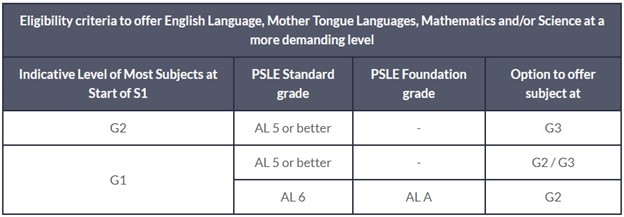
Eligible students can offer English Language, Mother Tongue Languages, Mathematics and Science at a more demanding level based on their PSLE Achievement Level (AL) for each of these subjects.
Beyond the start of Secondary One
From Secondary 2 (S2), students will also be able to offer Humanities subjects (Geography, History, and Literature in English) at a more demanding level. The criteria for taking Humanities at a more demanding level will be based on students' aptitude for and interest in these subjects at S1.
Eligibility Criteria for S2 Onwards
Humanities Subject Level at S1 | Humanities Subjects offering SBB | Eligibility Criteria | Option to offer Humanities at more demanding level in S2 |
G2 | History Geography | · 75% or higher in History and/or Geography G2 Level [Overall] · Passed Promotion Criteria for Sec 2 Normal (Academic) | G3 Geography and/or G3 History (i.e. can offer one or more Humanities subject at more demanding level) |
G1 | Humanities | • 75% or higher for English Language at G1 level, or the equivalent at G2 level [Overall] • A Pass with Distinction grade for both G1 Humanities Performance Tasks in Semester 1 and 2 • Passed Promotion Criteria for G1 | Student can choose to offer G2 Geography or G2 History at S2 |
Offering subjects at a Less Demanding Level
At the start of Secondary One
For students who offered English, Mathematics and/or Science at Foundation level at PSLE, but are otherwise eligible to take most of their subjects at G3 when entering secondary school, they may choose to take these subjects at a less demanding level (i.e., G2), in consultation with their secondary schools.
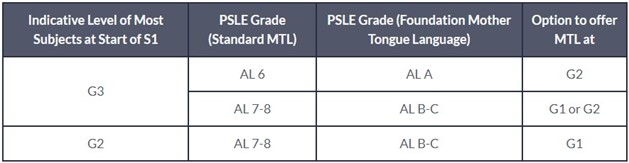
Students who face exceptional difficulties coping with their Mother Tongue Languages (MTL) will have the option to offer G1 or G2 MTL. At the start of Secondary One, students can offer MTL at a less demanding level based on the following criteria:
Beyond the start of Secondary One
Students may offer subjects at a less demanding level, based on their performance and schools’ holistic assessment, to calibrate their academic load.
Schools will also have the discretion to allow students with difficulties coping with MTL to offer MTL at a less demanding level, based on holistic considerations.
Students who offer subjects at a less demanding level may subsequently offer the subjects at a more demanding level as they gain greater competence and confidence in the subjects.
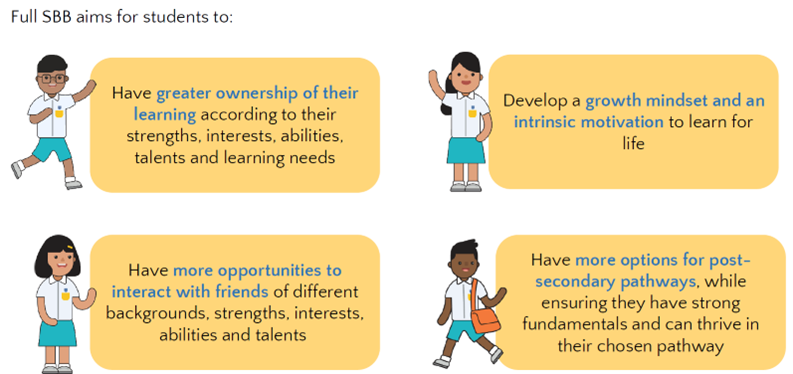
The increased flexibility empowers students to take greater ownership of their learning according to their subject-specific strengths and interests.
New Grading Scheme for Examinable Common Curriculum Subjects
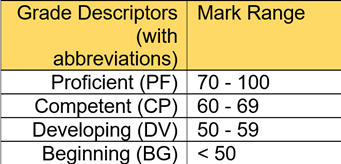
With effect from 2025, a new grading scheme will be implemented for examinable common curriculum subjects at lower secondary level. These subjects are Art, Design & Technology (D&T), and Food & Consumer Education (FCE). This grading scheme will provide clearer feedback on students’ progress and skills.
Under this new system, student performance will be assessed using a four-level grading scale:
How Full Subject-Based Banding (FSBB) benefits your child
More inclusive learning environment
Students learn alongside peers from different academic backgrounds, building empathy, respect, and understanding.Exposure to diverse strengths
Classroom discussions and group work allow students to appreciate how classmates contribute in different ways, not just academically.Learning pathways that match individual strengths
If your child excels in a subject, they can take it at a higher level, allowing them to be challenged and supported appropriately. FSBB encourages students to explore interests, discover what they are good at, and build confidence in their abilities.Development of life skills
Working with different peers helps students grow in e21cc skills in communication, teamwork, and critical thinking — skills that matter in school and beyond.Stronger preparation for post-secondary choices
Whether your child is inclined toward Sciences, Humanities, Arts, or Applied learning, FSBB opens up pathways that match their talents and long-term goals in post-secondary education.